Defence Software Development Company for India’s Defence and Aerospace Programmes
Secure systems for the programmes that cannot fail.
DigiWagon builds secure enterprise, asset-readiness, manufacturing and data systems for India’s defence public sector undertakings, private defence manufacturers, MSME suppliers and defence startups, and for the aerospace and shipbuilding integrators that serve them. Every system is engineered for the network it will live on and the inspection it will face — India first, export partners after.
Pick the situation closest to yours. We’ll show what we would build for it, where it sits in the defence services below, and which rule shapes it.
Pick what your programme has to prove
What it has to prove
Readiness Data That Lives in a Dozen Registers
Fleet status is in one system, maintenance history in another, spares in a register and inspection findings in a file, so readiness is a monthly compilation rather than a number anyone can trust today.
What we would build
What you could end up with
One readiness picture across fleets, depots and workshops
Failure and spares forecasts with documented features and review cadence
Maintenance schedules driven by condition, not the calendar alone
What it works with
Maintenance, inventory and depot systems already in service
Sensor, telematics and inspection records
The workshop and the formation that own the assets
A Production Line Under an Indigenisation Deadline
The contract carries an indigenous-content threshold, the inspecting authority samples every record, MSME suppliers send documents by email, and the shop floor still runs on spreadsheets.
What we would build
What you could end up with
Production, quality and traceability records the inspecting authority can sample
Indigenous-content accounting the contract can be audited against
Vendor portals that bring MSME suppliers into the programme
Manuals, standards, trial reports and decades of programme files exist, but finding the right page takes a day, and nothing may be sent to a service outside the network to help.
What we would build
What you could end up with
Searchable, source-backed knowledge that never leaves the network
Role-aware access that respects classification
Answers with the citation attached, not a summary
What it works with
Document repositories, manuals and technical publications
The system of record was written a decade or more ago, the people who understand it are retiring, and every proposal to replace it is a proposal to stop a programme that cannot stop.
What we would build
What you could end up with
An API layer over the legacy core so new capability ships beside it
Module-by-module re-platforming with a rollback position
Cutovers planned to exercise and inspection calendars
Defence software development for the depot, the shop floor and the classified network, from a defence technology company that builds for India’s procurement rules first: the defence software solutions below, each linked to the DigiWagon practice that builds it, with the aerospace and defence software work for export partners named where it applies.
01
Defence Digital Strategy & Compliance Discovery
Most defence software fails at accreditation, not in the demo: it assumed internet access the network does not have, a cloud the data may not leave, or a vendor licence the programme cannot carry. Discovery starts with the procurement and the boundary — the DAP 2020 category the programme sits in, its indigenous-content obligation, the classification of the data, the clearances the team will need — and settles the sequence: what to build, what to buy from an Indian OEM, what to leave alone. The output is a roadmap costed against accreditation risk, and a first release the unit or the plant will use.
Procurement-category and content mappingNetwork, classification and clearance auditBuild-buy-leave sequencingMVP definition with accreditation planned
Role-based operational applications for planning, tasking, reporting, inventory and administration, built to run on an air-gapped or restricted network with no dependency on a service outside it. Access follows the organisation’s roles and clearance levels; every action writes an audit record; deployments are reproducible from signed artefacts, because a patch may arrive on a disc rather than over a wire. We do not build weapon or fire-control systems; we build the enterprise and mission-support software around the programme, which is where most of the indigenisation work sits.
Planning, tasking and reporting workflowsRole- and clearance-based accessAudit records on every actionDisconnected, reproducible deployment
Readiness is a data problem before it is a spares problem. We build the models and dashboards that forecast component failure and spares demand from maintenance, inspection and sensor history, and turn them into schedules the depot can act on — with documented features, thresholds and review cadence, an explanation the maintenance officer can check, and drift monitoring in service. For a tractor OEM we built predictive maintenance across legacy and connected fleets — component issues detected 45% faster, unplanned-downtime risk down 35% — and the same pattern applies to vehicle, vessel and ground-equipment fleets.
Readiness dashboards by fleet and formationFailure and spares forecastingCondition-based maintenance schedulingModel documentation and drift monitoring
Defence Manufacturing, Quality & Indigenisation Systems
Production, quality and traceability systems for licensed defence manufacturers and their MSME suppliers, built for the inspecting authority as much as for the line: lot and serial traceability, non-conformance and inspection records in the form DGQA or DGAQA samples, and indigenous-content accounting the contract can be audited against. Vendor portals bring suppliers listed on SRIJAN or won through Make-II into the programme with their documents and certifications. For a multi-location manufacturer we joined production, attendance and wages on one platform — wage calculation 55% faster — the same shop-floor discipline.
Production and shop-floor trackingInspection and non-conformance recordsIndigenous-content accountingSupplier and MSME vendor portals
Inventory as a stream of events from receipt to issue, across depots, workshops and forward locations, with lot, serial and shelf life behind every count and reconciliation against the system of record. Demand signals feed the readiness models; supplier and indigenisation status sits on the same data; and a query about which lot went where answers in seconds rather than in a week of registers. Pipelines run inside the boundary with lineage recorded for every fact, so the auditor and the logistician read the same number.
Inventory as events across depotsLot, serial and shelf-life traceabilityDemand signals into readiness modelsLineage inside the boundary
Technical publications, maintenance manuals, standards, trial reports and decades of programme documents hold the knowledge, and finding the right page takes a day. We build source-backed retrieval and knowledge assistants that run entirely inside the network — no external model call, no data leaving the boundary — with access that respects classification and roles, and answers that carry their citation. For a global consumer-goods company we built the production-grade retrieval platform that made information 70% faster to find and cut manual knowledge discovery by 60%; the architecture is the same, the hosting is not.
Inside-the-boundary retrievalClearance- and role-aware searchGrounded answers with citationsSensor and operational data platforms
Inspection of components, assemblies, welds and coatings at line speed; condition monitoring of equipment from imagery; and review workflows in which a person confirms what the model flags. We design the optics, the model and the reject signal, validate against the programme’s own defect library, and integrate the result with the quality system so a defect becomes an inspection record with the image attached. Models are retrained under change control and documented for the certifying authority.
Component and assembly inspectionCondition monitoring from imageryHuman-review workflowsChange-controlled retraining
Defence enterprises run long-service systems that were never meant to talk, on networks that must not touch. We build the interfaces that connect them safely: controlled, logged data exchange between classification levels, one-way transfer where the policy demands it, identity and access integrated with the organisation’s directory, and monitoring that reports a stopped feed before operations notices. Idempotent processing means a duplicate message never creates a duplicate record, and every exchange keeps its evidence.
Controlled exchange between networksOne-way transfer where policy demandsDirectory-integrated identityFeed monitoring and evidence
Legacy System Modernisation for Long-Service Systems
Systems written a decade or more ago run programmes that cannot pause for a rewrite. An API layer goes in front of the legacy core first, so new applications, analytics and integrations ship beside it; modules are re-platformed one at a time — reporting, inventory, workflow — each run in parallel and reconciled before the old path is retired, with cutovers planned around exercise and inspection calendars and re-accreditation planned in rather than discovered. The organisation sees continuity; the team gets software it can change.
API enablement of the legacy coreModule-by-module re-platformingParallel runs and reconciliationCutovers to exercise calendars
Segregated environments, signed artefacts, dependency and secrets scanning, software bills of materials, access reviews and incident records — produced by the pipeline as it runs, so the CERT-In, ISO/IEC 27001 and programme-security evidence exists because the work was done. Deployments are designed for disconnected delivery: a release that can be carried onto the network, verified and installed without an internet connection, and rolled back the same way.
Signed artefacts and SBOMsDependency and secrets scanningDisconnected release deliveryIncident and access records
Where the data may live is decided before the architecture is: on-premise and air-gapped for classified programmes, MeitY-empanelled Indian cloud for the rest, hybrid where a programme spans both. We design the environments, the identity model, the network segmentation and the resilience for each, with the residency and audit records the security accreditation asks for, and a cost model the programme office can defend.
Air-gapped and on-premise environmentsMeitY-empanelled sovereign cloudSegmentation and identity designResidency and audit records
The building blocks behind the platforms above, grouped the way a programme office scopes them. Pick a group to see what we have built inside it.
01 / 05
Readiness, Maintenance & Fleet
01Asset readiness dashboards
02Condition-based and predictive maintenance
03Spares demand forecasting
04Depot and workshop work orders
05Fleet health across legacy and connected assets
06Service history and configuration records
02 / 05
Manufacturing, Quality & Indigenisation
01Production planning and shop-floor tracking
02Inspection and non-conformance records
03Lot and serial traceability
04Indigenous-content accounting
05Supplier and MSME vendor portals
06Test and trial documentation
03 / 05
Data, Knowledge & Intelligence
01Inside-the-boundary data platforms
02Source-backed knowledge assistants
03Clearance-aware document search
04Sensor and operational data analysis
05Computer vision for inspection
06Reporting with lineage
04 / 05
Integration, Identity & Modernisation
01Controlled data exchange between networks
02One-way transfer where policy demands
03Directory-integrated identity and access
04API enablement of legacy systems
05Module-by-module re-platforming
06Parallel runs and reconciliation
05 / 05
Security, Hosting & Evidence
01Air-gapped and disconnected deployment
02MeitY-empanelled sovereign cloud
03SBOMs, signed artefacts and scanning
04Audit trails on every action
05CERT-In incident and log readiness
06Accreditation evidence by pipeline
Who we build for
Programmes We Build For
Five kinds of organisation in India’s defence ecosystem, each with its own procurement route, inspecting authority and network. The data, integration and modernisation patterns transfer between them; the boundary does not.
Defence Public Sector Undertakings
The seven companies carved out of the Ordnance Factory Board in 2021 and the older DPSUs run some of the longest-serving systems in the country. We modernise them module by module, connect the shop floor and the depot, and build the data and knowledge platforms that stay inside the boundary.
Private Defence Manufacturers & MSME Suppliers
Licensed manufacturers and the suppliers behind them carry indigenous-content obligations, inspection regimes and delivery schedules at once. Production, quality, traceability and vendor systems built for the inspecting authority as much as for the line.
Defence Startups & iDEX Winners
A prototype that won a challenge has to become a product that passes accreditation and scales to a programme. We build the platform, the security engineering and the evidence around it, so the next conversation is about the contract and not the codebase.
Aerospace, Shipbuilding & MRO Integrators
Configuration, maintenance and certification records across long asset lives, with DGAQA, CEMILAC or classification-society expectations behind every entry. Readiness analytics, MRO systems and document intelligence that treat the certificate as a first-class record.
The buyer’s own depots, workshops, training establishments and administrative units, where inventory, personnel and readiness data still live in registers. Secure enterprise applications that run on the network as it is, and modernisation that respects the exercise calendar.
Compliance by design
Compliance Is Architecture
Defence software is judged by rules the demo never shows: the procurement category and its indigenous-content threshold, who may see which record, where data may be hosted, what the inspecting authority samples, how quickly an incident must be reported, and what may cross a border. We treat each as a design constraint rather than a badge. Every framework below binds at least one of the services above, because that is where it is implemented.
The procurement categories a programme is bought under and the indigenous-content thresholds they carry; the reason our manufacturing and vendor systems account for content by component, not by declaration.
Manufacturing & indigenisationDiscovery
02
iDEX and the Defence India Startup Challenges; DRDO’s Technology Development Fund
The innovation routes by which a prototype becomes a procurement; the platform, security and evidence work between a challenge win and a contract is where startups most often stall.
StartupsSecurity engineering
03
The Positive Indigenisation Lists (MoD, 2020 onward) and the SRIJAN indigenisation portal
Import-embargo timelines by item and the portal where DPSUs list what they want made in India; vendor systems read both, so a supplier’s opportunity and obligation sit on one record.
Manufacturing & indigenisationSupply chain
04
DGQA and DGAQA quality assurance; CEMILAC military airworthiness certification
The inspecting and certifying authorities whose sampling and documentation expectations shape every quality, traceability and configuration record the software produces.
Manufacturing & qualityMROComputer vision
05
Information Technology Act 2000 and the CERT-In Cyber Security Directions (28 April 2022)
Incident reporting within six hours, 180 days of logs retained in India and synchronised time sources; designed into the platform’s logging and incident tooling rather than bolted on.
Security engineeringHosting
06
Digital Personal Data Protection Act 2023
Consent, purpose limitation, retention and breach duties for the personnel, contractor and citizen data a defence enterprise necessarily holds, applied alongside the programme’s own security rules.
Enterprise applicationsData platforms
07
Official Secrets Act 1923; industrial licensing under the IDR Act 1951 and MHA security clearance for defence manufacturers
The classified-information duties and facility-security expectations that follow a licence into its software suppliers: cleared staff, controlled premises, controlled media.
Every engagement
08
MIL-STD-498 and ISO/IEC/IEEE 12207:2017 software life-cycle processes; DO-178C for airborne software
The life-cycle documentation defence programmes still specify, and the airborne software assurance levels certified through CEMILAC; requirements, design and test records are produced with the code.
Mission-support applicationsMROModernisation
09
MeitY-empanelled cloud service providers; STQC testing and certification
Where government and defence data may be hosted in India, and the body that tests and certifies software for it; the hosting decision is made in discovery, not after the build.
HostingSecurity engineering
10
SCOMET (DGFT export controls), ITAR and EAR; NIST SP 800-171 Rev. 3 and CMMC 2.0 for US supply-chain work
Dual-use export rules when a system or its data crosses a border, and the controls a US prime’s supplier must evidence; scoped in only where an export or offset partner is involved.
Aerospace & export partnersSecurity engineering
11
ISO/IEC 27001:2022 and ISO 9001:2015
Information security and quality management. DigiWagon holds both certifications; the platform’s pipeline generates the evidence for the programme’s own accreditation as it runs.
Every engagement
Certification is a claim we make only about ourselves. For everything else on this list, the system is built for the rule and the evidence is produced with the code.
How we work
How a Defence Build Runs
Defence software development starts with the boundary and the procurement, not the feature list: which network the system lives on, which category it is bought under, who must be cleared, what the inspecting authority will sample, and what the programme cannot afford to have stop. Everything else is sequenced from there.
01
Discover the Boundary
Map the network, the classification, the clearances and the procurement category before scope is fixed, walk the depot or the line, and find the registers that hold the programme together, so the plan is costed against accreditation risk rather than against a demo.
Role and clearance models, audit trails, disconnected deployment, hosting inside the boundary and the life-cycle documents the programme specifies are designed as features, because the cheapest time to produce accreditation evidence is while the system does the work.
Focus
Roles & clearanceAudit trailsDisconnected deployLife-cycle records
03
Build Behind the Wire
Cleared engineers, controlled repositories and signed artefacts; releases carried onto the network and verified there; parallel runs against the legacy system reconciled before anything is retired; cutovers planned to exercise and inspection calendars with a rollback position.
Focus
Cleared teamSigned artefactsParallel runRollback
04
Run Under Inspection
Readiness, incident, access and change records are produced by the system as it runs, model drift and feed health are watched inside the boundary, and the evidence the inspecting authority or the security accreditor asks for is a report, not a reconstruction.
Focus
EvidenceDriftFeed healthRe-accreditation
Discover01 Discover the BoundaryDesign02 Design for AccreditationBuild03 Build Behind the WireRun04 Run Under Inspection
Insights
Notes From the Boundary.
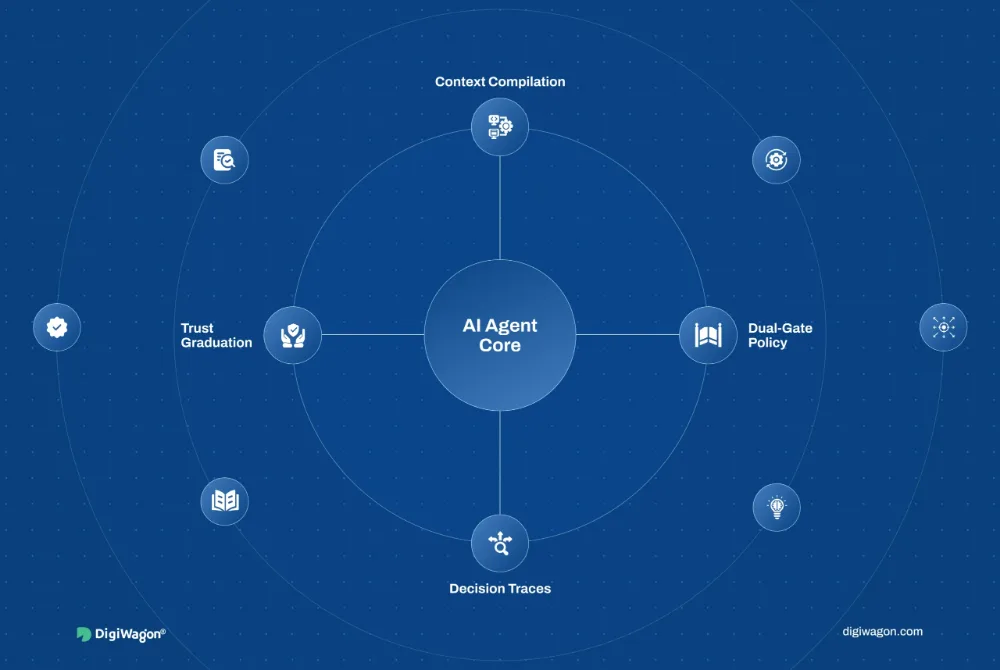
Writing that defence buyers read for a reason: sovereign sourcing and data residency, a zero-trust roadmap for every stage of a build, and governed AI agents behind a decision harness.
AI & Machine Learning
Governed Enterprise AI Agents: A Decision-Harness Architecture
· Kartik Gajjar · 10 min read
Software Engineering
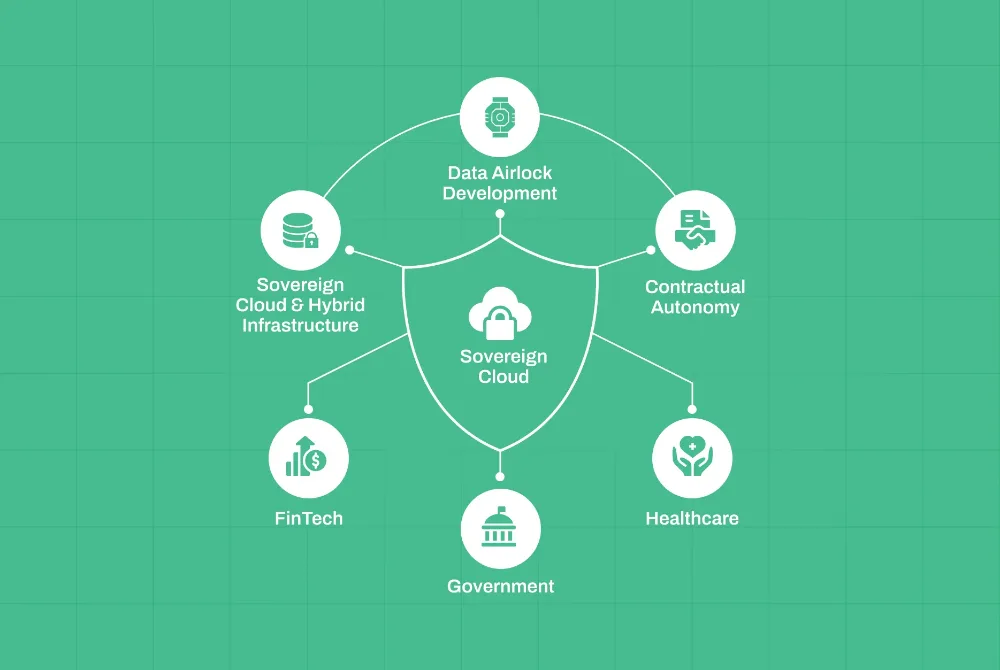
The Sovereign Sourcing Framework: Balancing Global Outsourcing with Data Residency in UAE & Europe
· Rushabh Modi · 4 min read
Cloud & Platform Engineering
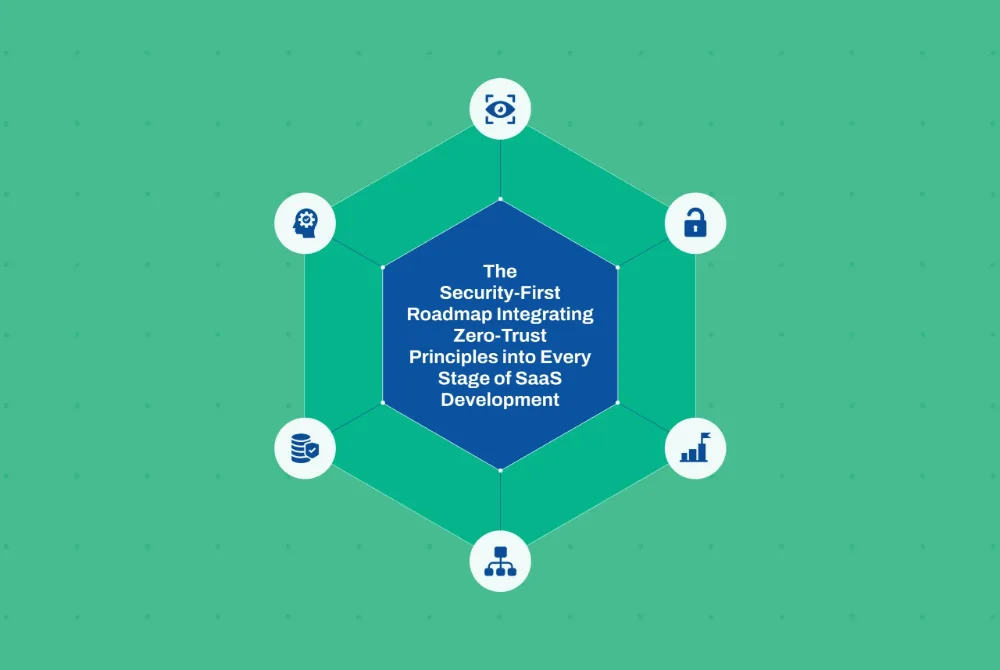
The Security-First Roadmap: Integrating Zero-Trust Principles into Every Stage of SaaS Development
Frequently Asked Questions About Defence Software Development
Direct answers on building for air-gapped networks, what DAP 2020 and indigenous content change about a software build, how security clearance and CERT-In duties are handled, where AI belongs in a classified environment, and what a defence software development company should be able to show you.
01Can you build and support software for air-gapped or restricted defence networks?
Yes, and it changes the engineering more than the feature list. Nothing in the system may depend on a service outside the network: no external model calls, no cloud identity, no telemetry home. Releases are built from signed artefacts, carried onto the network, verified and installed there, and rolled back the same way. Knowledge assistants, dashboards and integrations all run inside the boundary.
02What do DAP 2020 and indigenous content change about a software build?
The procurement category sets the indigenous-content threshold, and software is part of the content. We design so the programme can prove it: Indian-hosted, Indian-built components accounted for by item, third-party licences chosen with the threshold in mind, and manufacturing systems that record content by component rather than by declaration. Make-II and iDEX routes add their own documentation, which we plan for in discovery.
03How do you handle security clearance, the Official Secrets Act and CERT-In duties?
As conditions of the engagement rather than paperwork afterwards. Engineers on classified work are vetted to the programme’s requirement, repositories and media are controlled, and premises follow the licence-holder’s security rules. Logging keeps 180 days of records in India with synchronised time, incident tooling supports six-hour reporting to CERT-In, and every action in the system writes an audit record the accreditor can read.
04Where does AI belong in a classified defence environment?
Wherever a person still decides. Predictive maintenance, spares forecasting, document retrieval and inspection models earn their place when they run inside the boundary, explain their outputs, keep a reviewer in the loop and log every decision. Models are documented and monitored for drift, and the hosting is decided first — on-premise or sovereign cloud — so no data leaves the network to be analysed.
05Have you shipped defence platforms, or is your experience adjacent?
Adjacent, and we say so: no defence case study is published on this site yet. The published work that transfers is named where it appears — predictive maintenance across legacy and connected fleets, a production and workforce platform for a multi-location manufacturer, a source-backed knowledge platform over millions of documents, and audit-ready compliance platforms for regulated institutions. Ask for the detail behind each before anything is scoped.
Build for the Network You Actually Have
Tell us which network the system must live on, which category it is bought under and what the programme cannot afford to have stop. We will map the boundary, the clearances and the data, and show you comparable regulated and industrial work before anything is scoped.
One click opens the assistant you already use with a question that points it at this page, so the answer comes from what we publish, not a guess.
The question it opens withRead https://digiwagon.com/defence-software-development. Outline how DigiWagon approaches Defence engineering and compliance, then tell me what a Defence CTO should verify before choosing them or any similar partner. Stick to what the page says and mark anything you are not sure about.