eCommerce and Retail Software Development for Commerce Platforms
Commerce systems built for peak day, not launch day.
DigiWagon builds storefronts, order and inventory systems, loyalty and personalization platforms and the integrations behind them for retailers, D2C and B2B brands, marketplaces and consumer-goods companies in the United States, the United Kingdom and India. Every platform is engineered for the peak-day order and the returns desk, not just the launch.
Pick the situation closest to yours. We’ll show what we would build for it, where it sits in the commerce services below, and which rule shapes it.
Pick what your platform has to prove
What it has to prove
A Storefront That Buckles on Peak Day
The site is fine at Tuesday traffic and falls over on the promotion the marketing team forgot to mention, checkout errors spike, and nobody can say whether it was the search service or the payment provider.
What we would build
What you could end up with
A storefront that renders fast on a phone on a bad connection
Checkout tested against the peak the plan expects, not the average
Catalog, pricing and promotions as data merchandisers change without a release
Inventory the Store, the Site and the Warehouse Disagree On
The site sold what the shelf did not have, the store cannot see what the warehouse holds, and the promise date was made by a system that never asked either of them.
What we would build
What you could end up with
One inventory position across stores, warehouses and 3PLs, updated as events
Order orchestration that picks the cheapest promise you can keep
Returns and exchanges built into the order, not bolted on
Customers You Recognize in One Channel and Not the Other
The loyalty member in the store is a guest on the site, the app knows a different address, and marketing sends an offer for a product the customer returned last week.
What we would build
What you could end up with
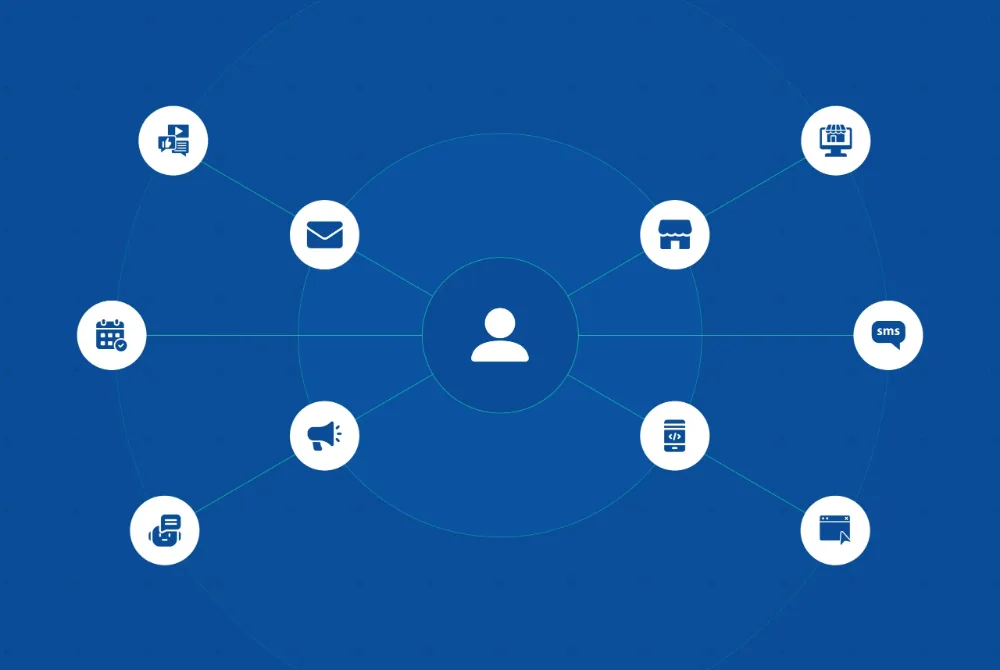
One customer profile across store, site, app and marketplace
Loyalty and offers that respect consent and margin
Segments and lifetime value the merchandiser can act on
The platform is end-of-life, the customizations cannot be upgraded, and every proposal to move it is a proposal to risk the rankings, the orders and the customer accounts at once.
What we would build
What you could end up with
A migration plan with URL, SEO and order continuity as first-class requirements
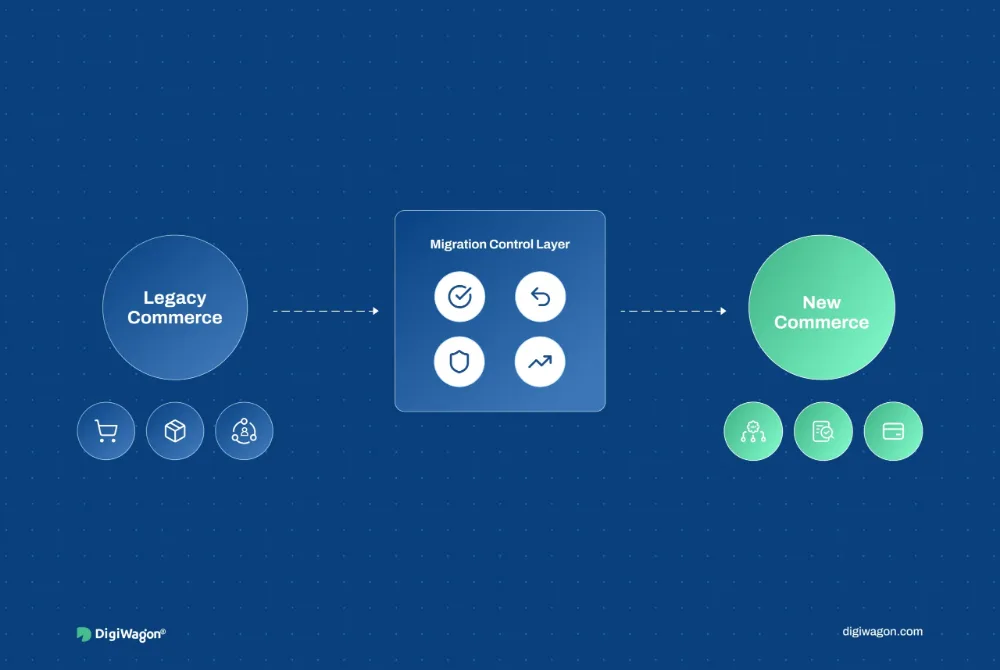
Capabilities moved one at a time behind a routing layer
Retail and ecommerce software for the storefront, the store and the back office, from an ecommerce software development company that has built for both: the storefronts, order systems, customer platforms and integrations below, each linked to the DigiWagon practice that builds it. Retail software development here means the systems a retailer runs; ecommerce software development means the ones a customer touches; most programs need both.
01
Retail & Commerce Digital Strategy
Most commerce programs fail on the eleventh promotion, not the first: the platform assumed a catalog that does not change weekly, an order flow that never splits, or a returns rate the business case ignored. Discovery starts with how the business actually sells — channels, margins, promotions, fulfillment promises, returns — and settles the sequence: what to build, what to buy, what to integrate, what to retire. The output is a roadmap costed against conversion, cost to serve and peak-day risk, and a first release the teams will use.
Channel, margin and returns discoveryBuild-buy-integrate sequencingPlatform and vendor evaluationMVP definition with adoption planned
Storefronts built as fast, accessible front ends over a commerce engine, so the experience changes at the pace of marketing and the engine changes at the pace of finance. Catalog, pricing, promotions and content are modeled as data merchandisers edit without a release; checkout is instrumented, tokenized and tested against the peak the plan expects; and search, media and consent are integrated rather than pasted in.
Headless and composable storefrontsCatalog, pricing and promotion managementInstrumented, tokenized checkoutSearch, media and consent integration
Account-specific catalogs and pricing, quotes, approvals, credit terms, punch-out and bulk ordering for distributors and manufacturers selling to businesses, and multi-vendor marketplaces where the platform owns the buyer relationship and the vendors own the stock. Contract pricing and entitlements are data with effective dates; orders flow into the ERP with the references finance needs; and vendor onboarding, catalog ingestion and settlement are built as product features.
Account pricing, quotes and approvalsPunch-out, bulk and repeat orderingVendor onboarding and catalog ingestionMarketplace settlement and payouts
Shopping apps, loyalty wallets, click-and-collect, scan-and-go, store associate tools and kiosk experiences built for the aisle and the queue, not the boardroom demo. Apps share the same catalog, inventory and customer services as the storefront, so a price or a stock position is never different on the phone. For a multi-brand service network we built the consumer web and mobile platform for booking, real-time tracking and workshop coordination in several languages — service tracking 50% faster, coordination 40% smoother — the same pattern a retail chain’s customer app and store tools follow.
Shopping and loyalty appsClick-and-collect and scan-and-goStore associate and kiosk toolsShared services across app, site and store
Order management that orchestrates every channel’s orders against one inventory position, chooses the fulfillment node that keeps the promise cheapest, and handles splits, backorders, exchanges and returns as part of the order rather than as exceptions. Inventory is a stream of events from stores, warehouses and 3PL partners, reconciled to the ERP, so the site never sells what the shelf does not have. Returns and reverse logistics are designed in from the start, because a retailer’s margin is decided as much at the returns desk as at checkout.
Distributed order managementInventory as events across channelsShip-from-store and click-and-collectReturns, exchanges and reverse logistics
A retailer’s stack is a dozen systems that were never introduced to one another: POS, ERP, WMS, payment providers, tax engines, carriers, marketplaces, loyalty, support and marketing. We build the integration layer that makes them one flow — event-driven, idempotent so a retried webhook never duplicates an order, with dead-letter queues and monitoring that tells you a feed stopped before customers do. Payments are integrated through tokenizing providers, so card data never touches your systems and the PCI DSS scope stays narrow, and tax, shipping and marketplace connectors onboard by configuration.
POS, ERP and WMS connectorsPayment provider orchestration and tokenizationTax, shipping and marketplace integrationIdempotent flows with monitoring
One customer record across store, site, app and marketplace, built on a governed data layer with consent, preferences and lawful basis attached to every attribute, so recognition is a service you offer rather than a surveillance the regulator asks about. Loyalty programs, tiers, offers and gamified rewards run as configuration on that record; lifetime value, churn and segment analytics run on the same data, so marketing and finance read the same numbers.
Unified customer profiles with consentLoyalty tiers, rewards and gamificationLifetime value and churn analyticsExplainable identity resolution
Recommendation, search ranking, next-best-offer and dynamic merchandising models trained on your own browsing, purchase and inventory data and constrained by margin, stock and consent. Every model ships with documented features, an offline and an online evaluation, guardrails for the products it must never promote, and monitoring for drift and for the fairness questions a regulator may ask. The retail data analytics behind it — which products convert, where journeys break, what a segment is worth — runs on the same governed layer, so the model and the dashboard never disagree.
Recommendations and next-best-offerPersonalized search and rankingMargin, stock and consent constraintsEvaluation, guardrails and drift monitoring
Sell-through, margin, stock cover, promotion lift, basket and channel analytics calculated once and read the same way by merchandising, stores, e-commerce and finance, with lineage from the dashboard back to the transaction. Demand and replenishment forecasts by store and SKU sit on the same data, so the forecast and the actual it is compared against come from one source. For a global consumer-goods company we built a knowledge platform over millions of documents for R&D and compliance teams — information 70% faster to find — and the analytics discipline is the same.
Sell-through, margin and stock coverDemand and replenishment forecastingPromotion lift and basket analysisRole-based dashboards with lineage
Interactive product hubs, simulators, guided selling and self-serve learning tools that explain a product’s technology to sales teams, partners and customers better than a PDF ever did. For a leading consumer-goods brand we built an interactive web hub that turned its product technology into simulators and self-serve learning, streamlining internal communication and building confidence in the product across teams. The design work is research-led: who needs to understand what, in which moment, on which device, and what confident adoption looks like when it is measured.
Interactive product and technology hubsSimulators and guided sellingSelf-serve learning for teams and partnersResearch-led design and measurement
Replatforming a store is the migration nobody wants to own, because everything is visible: URLs, rankings, orders, customer accounts, integrations. We do not switch it off and on. URL mapping and redirects, search continuity and order history are first-class requirements; capabilities move one at a time behind a routing layer; each cutover runs in parallel and reconciles before the old path is retired; and there is a rollback position at every step.
URL, redirect and ranking continuityCapability-by-capability cutoverParallel runs and order reconciliationRollback at every step
The building blocks behind the platforms above, grouped the way a retail leadership team scopes them. Pick a group to see what we have built inside it.
01 / 05
Storefront & Checkout
01Headless and composable storefronts
02Catalog, pricing and promotion management
03Multi-platform cart and checkout
04Tokenized payments and wallets
05Discount, coupon and bundle engines
06Site search and merchandising
02 / 05
Orders, Inventory & Fulfillment
01Distributed order management
02Real-time inventory across channels
03Click-and-collect and ship-from-store
04Returns, exchanges and reverse logistics
053PL, carrier and marketplace connectors
06Tax and duty calculation by region
03 / 05
Customer, Loyalty & Personalization
01Unified customer profiles with consent
02Loyalty tiers, rewards and gamification
03Recommendations and next-best-offer
04Personalized search and ranking
05Subscription and replenishment commerce
06Customer service and case tooling
04 / 05
Data, Analytics & Intelligence
01Sell-through, margin and stock cover
02Demand and replenishment forecasting
03Promotion lift and basket analysis
04Journey and conversion analytics
05Product knowledge and content hubs
06Role-based dashboards with lineage
05 / 05
Integration, Payments & Compliance
01POS, ERP and WMS integration
02Payment provider orchestration
03PCI DSS scope reduction by tokenization
04Consent, cookies and privacy by design
05WCAG 2.2 accessibility
06Audit trails and evidence by design
Who we build for
Retailers We Build For
Five kinds of seller, each with its own margin, calendar and failure modes. The order, customer and integration patterns transfer between them; the promise made to the customer does not.
Online Retailers & D2C Brands
A storefront, a promise and a returns rate. Fast, accessible storefronts over a commerce engine, subscription and replenishment models, and the order and customer platforms that keep the promise the site made — engineered for the promotion day, not the launch day.
Brick-and-Mortar & Omnichannel Chains
Stores that must now behave like the site: click-and-collect, ship-from-store, scan-and-go, associate tools and one inventory position across the network. Integration with POS and ERP is most of the work, and the customer app is built on the same services as the store.
B2B Distributors & Marketplaces
Account pricing, quotes, approvals, credit and bulk orders for buyers who would otherwise phone, and marketplaces where vendors own the stock and the platform owns the buyer. Portals that buyers prefer to the spreadsheet are the only kind that pay back.
FMCG & Consumer Goods Companies
Products that change fast and knowledge spread across teams and documents. For a leading consumer-goods brand we built an interactive product-education hub with simulators and self-serve learning; for a global one, a knowledge platform that made information 70% faster to find.
Franchise & Multi-Brand Groups
Headquarters needs one view, outlets need autonomy, and the customer expects the same experience under every sign. Multi-tenant platforms, shared catalogs with local pricing, consolidated reporting and loyalty that works across brands — the pattern of the multi-brand service network we built.
Compliance by design
Compliance Is Architecture
Commerce software is judged by rules the customer never sees: how card data is handled, when a payment must be challenged, what a customer must be told before buying, what consent covers, whether the storefront can be used with a screen reader, and which tax applies to which basket. We treat each as a design constraint rather than a badge. Every framework below binds at least one of the services above, because that is where it is implemented.
01
PCI DSS v4.0.1
Card data security for every storefront, app and store system that takes payment; tokenizing providers and hosted fields keep the platform in the narrowest SAQ, and the evidence is produced by the pipeline.
Checkout & paymentsIntegration
02
PSD2 Strong Customer Authentication (EU) and UK SCA; EMV 3-D Secure 2
Two-factor authentication rules for card payments in Europe and the UK, applied through 3-D Secure with exemptions handled, so conversion is not sacrificed to compliance.
Checkout & payments
03
GDPR, UK GDPR, CCPA/CPRA and India’s DPDP Act 2023
Lawful basis, consent, cookies, marketing preferences, profiling limits, retention and subject rights for the customer data a retailer necessarily holds, applied per market.
Customer dataPersonalizationStorefronts
04
WCAG 2.2 Level AA; ADA Title III; the European Accessibility Act (applies from 28 June 2025)
Accessible storefronts, apps and kiosks as a legal duty in the US and Europe and a conversion advantage everywhere; tested with assistive technology, not only with a checker.
StorefrontsMobile appsIn-store digital
05
UK Consumer Contracts Regulations 2013, the EU Consumer Rights Directive and India’s Consumer Protection (E-Commerce) Rules 2020
Pre-contract information, cancellation and returns rights, seller and grievance disclosures for online sales; modeled as data per market rather than as a footer paragraph.
CheckoutReturnsMarketplaces
06
US sales tax after South Dakota v. Wayfair (2018); UK and EU VAT with the OSS and IOSS schemes
Nexus, destination-based rates, marketplace facilitator rules and cross-border VAT collection; handled by a tax engine integrated at checkout and reconciled in the ERP.
CheckoutIntegrationMarketplaces
07
GS1 standards — GTIN, GS1 Digital Link and EPCIS 2.0
Product identification across channels and partners, QR codes that resolve to product data, and the event vocabulary traceability and recall queries are built on.
CatalogInventory & fulfillment
08
CAN-SPAM and the TCPA (US), PECR (UK) and the ePrivacy rules
Consent and opt-out rules for email, SMS and tracking; loyalty and personalization engines read the preference record before they send anything.
LoyaltyMarketing integration
09
ISO/IEC 27001:2022 and SOC 2 Type II
Information security management and evidenced controls. DigiWagon holds ISO/IEC 27001 and ISO 9001 certification; the platform’s pipeline generates the SOC 2 evidence as it runs.
Every engagement
Certification is a claim we make only about ourselves. For everything else on this list, the platform is built for the rule and the evidence is produced with the code.
Retail & eCommerce
Retail & eCommerce in practice
Product training for a consumer-goods brand.
Challenge
A leading FMCG company needed a clear way to explain its stain-shield deodorant tech across teams. We built an engaging digital hub with simulators and self-serve learning tools, streamlining communication, saving time, and boosting product confidence.
What DigiWagon built
DigiWagon built an interactive internal product innovation hub that became the single source of truth for the deodorant technology. The platform combined product storytelling, virtual demos, interactive learning, clear content structure, and scalable web development. It helped teams understand the innovation without repeated manual explanations.
Ecommerce software development starts from the order path and the peak calendar, not the feature list: how the business sells and returns, which systems hold the truth, what the promotion calendar will do to load, and what the storefront cannot afford to lose during a change. Everything else is sequenced from there.
01
Discover the Order Path
Follow an order from search to return across every channel and system, read the promotion calendar and the returns data, and map the systems of record before scope is fixed, so the plan is costed against conversion and cost to serve rather than against a demo.
Focus
Order pathChannelsPromotionsSystems of record
02
Design for Peak and Returns
Checkout under the load the plan expects, inventory as events, returns inside the order, consent attached to every customer attribute and accessibility from the first component are designed as features, because retrofitting any of them costs a season.
Focus
Peak loadEventsConsentAccessibility
03
Build Behind the Live Store
New capabilities ship behind a routing layer while the store trades, integrations are certified against sandboxes before a live order touches them, and each cutover runs in parallel and reconciles orders and inventory before the old path is retired.
Conversion, checkout errors, feed health, model drift and stock accuracy are watched in production, releases are frozen when the calendar says so, and the PCI, privacy and consumer-law records the assessor asks for are produced by the platform as it runs.
Focus
ConversionFeed healthRelease calendarEvidence
Discover01 Discover the Order PathDesign02 Design for Peak and ReturnsBuild03 Build Behind the Live StoreRun04 Run Through the Season
Insights
Notes From Commerce Builds.
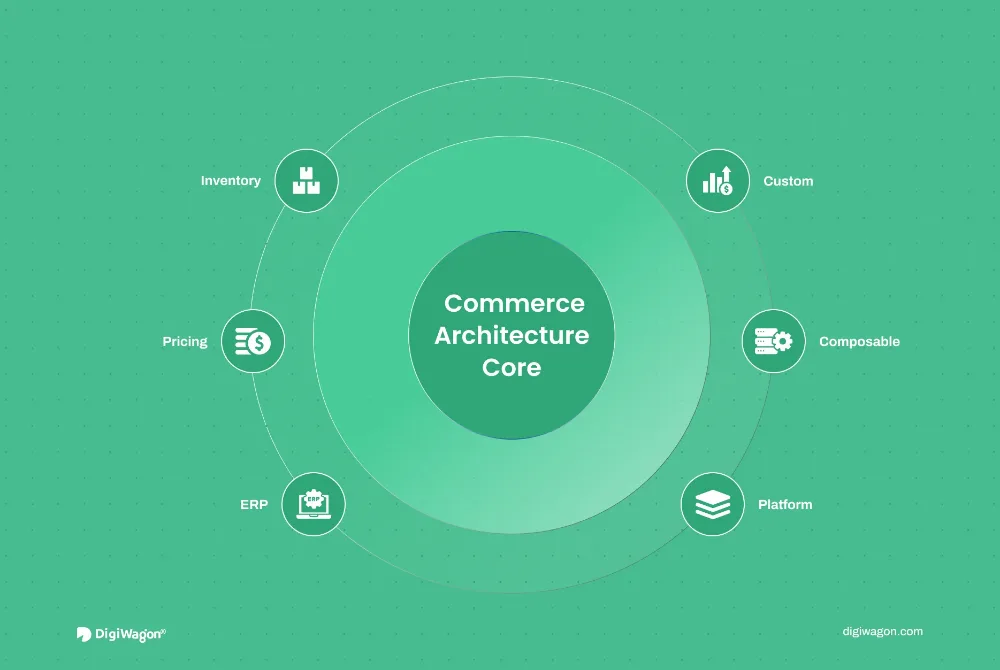
Writing from the commerce work: omnichannel platforms for D2C brands, a risk playbook for replatforming an enterprise store, and how to choose between custom, composable and platform architectures for B2B commerce.
Software Engineering
eCommerce Migration: A Strategic Risk Playbook for Enterprise Replatforming
· Divyarajsinh Gohil · 6 min read
Software Engineering
B2B eCommerce Architecture: Custom vs. Composable vs. Platform
· Divyarajsinh Gohil · 10 min read
Software Engineering
Unifying the Experience: Building a True Omnichannel E-commerce Platform for D2C Brands in 2026
Frequently Asked Questions About eCommerce and Retail Software Development
Direct answers on what a modern commerce platform needs beyond the storefront, how POS, ERP and payment systems are integrated without disrupting trading, how personalization respects privacy law, how a store is replatformed without losing rankings or orders, and what an ecommerce software development company should be able to show you.
01What should a modern eCommerce platform include beyond the storefront?
Order management across every channel, one inventory position updated as events, returns designed into the order, a customer record with consent attached, tokenized payments, tax and shipping engines, and integrations that fail loudly rather than silently. The storefront is the visible tenth; the other nine tenths decide whether the promise the site makes is one the warehouse and the returns desk can keep.
02Can you integrate with our POS, ERP, WMS and payment providers without disrupting trading?
Yes. Integrations are built event-driven and idempotent, so a retried message never duplicates an order, and each one is certified against the partner’s sandbox before a live transaction touches it. Cutovers run in parallel with the existing flow and reconcile orders, payments and stock before the old path is retired. Payments go through tokenizing providers, so card data never enters your systems and the PCI scope stays narrow.
03How do you personalize the customer experience without breaking privacy rules?
By attaching consent and lawful basis to every attribute in the customer record and letting the models read it. Recommendations, offers and messaging respect the preference record per market — GDPR and UK GDPR, CCPA, India’s DPDP Act — profiling is explainable and reversible, and the products a model must never promote are guardrails, not hopes. Personalization built this way converts better, because customers trust it.
04How do you replatform a store without losing SEO rankings and orders?
URL mapping, redirects, search continuity and order history are treated as requirements, not migration chores. Capabilities move one at a time behind a routing layer while the store trades; each cutover runs in parallel and reconciles before the old path is retired; and there is a rollback position at every step. Rankings are monitored through the change, and the release calendar respects the promotion calendar.
05What retail and eCommerce work have you shipped?
One published case study is consumer-goods work: an interactive product-education hub with simulators and self-serve learning tools for a leading consumer-goods brand. The rest of the proof is adjacent and named as such — a consumer web and mobile platform for a multi-brand service network with real-time tracking, paperless onboarding with 98% identity-verification accuracy, and a knowledge platform for a global consumer-goods company. Ask for the detail behind each.
Build Commerce That Holds on Peak Day
Tell us how you sell, where the stock lives and what the promotion calendar does to your platform. We will follow an order from search to return, map the systems and the integrations, and show you comparable work before anything is scoped.
One click opens the assistant you already use with a question that points it at this page, so the answer comes from what we publish, not a guess.
The question it opens withRead https://digiwagon.com/retail-and-ecommerce-software-development-company. Outline how DigiWagon approaches Retail & eCommerce engineering and compliance, then tell me what a Retail & eCommerce CTO should verify before choosing them or any similar partner. Stick to what the page says and mark anything you are not sure about.